
How to Learn Chinese from Zero: A 90-Day Beginner Roadmap
Search “learn Chinese in 90 days” and you get a wall of promises that don’t survive contact with reality: fluent by autumn, conversational by the time the weather turns, speaking “like a local” in one season. None of that happens for anyone, in any language, and Chinese least of all. What actually happens in 90 days, if you spend them on the right things in the right order, is smaller and far more useful: a daily habit that survives the point where most learners simply stop, and a real, countable stack of vocabulary and grammar under it. This is that plan, week by week, built from the exact course order, review engine, and free tools behind Merry Mandarin, not a generic list of study tips.
What 90 days can honestly get you
Not fluency. Nobody reaches fluency in 90 days of anything, and a roadmap that promised it would be lying to you in the first paragraph. What 90 days of consistent, structured study genuinely delivers is a foundation: the tones and strokes stop being effortful, a few hundred words move from “recognized” to “recalled,” and the first layer of grammar (negation, questions, possession, measure words) becomes automatic rather than something you look up each time.
How much vocabulary depends almost entirely on how much time you actually give it each day, not on talent, and the honest number has to count the time spent learning new material, not just reviewing what’s already familiar. A brand-new tone or grammar pattern always takes longer to absorb the first time than a card you’re just refreshing, and any estimate that only counts review speed is flattering itself. Scaled from the same FSI-based hours behind our full fluency timeline calculator, here is roughly what a few honest daily commitments add up to over 90 days:
| Daily time | Words mastered in 90 days | Roughly where that lands you |
|---|---|---|
| 5 minutes | ≈30 words | The first stretch of HSK 1: tones, strokes, first greetings |
| 15 minutes | ≈90 words | Roughly halfway through HSK 1 |
| 30 minutes | ≈160 words | HSK 1 finished, just starting HSK 2 |
| 60 minutes | ≈300 words | HSK 1 and 2 finished, right at the edge of HSK 3 |
These numbers already include lesson time, not just review time, since a review-only estimate would count the fast half of the work and ignore the slow half. They’re also scaled estimates, not a guarantee: skip days and they slide, and a single Saturday catch-up session doesn’t fully recover the lost ground, because spaced repetition rewards consistency more than it rewards total hours. The honest takeaway is not “pick the biggest number.” It’s “pick the number you can actually hold for 90 days in a row without heroics,” which is a smaller number than most beginners choose in week one.
Ninety days is also not an arbitrary length. A widely cited 2009 University College London study on habit formation found that new daily habits took 66 days to feel automatic on average, ranging from 18 to 254 days depending on the person and the behavior. Thirty days ends before most people cross that line, which is exactly why so many “30-day Chinese challenge” plans produce a burst of enthusiasm followed by a stall. Ninety days clears the average with three to four weeks of margin left over, enough for the habit to outlast the motivation that started it.
The 90 days at a glance
-
Days 1-30: Foundation
Tones, stroke basics, pinyin or zhuyin, and the first grammar patterns. Goal: reviews stop feeling foreign and the first real vocabulary starts sticking.
-
Days 31-60: Momentum
Characters start arriving as systems of components instead of random pictures. HSK 1 finishes, HSK 2 begins, and the first real sentences get spoken out loud.
-
Days 61-90: Consolidation
Sentence-level review takes over from single words, the first real graded reading happens, and the daily habit crosses from effortful into automatic.
Before day 1: three decisions that save you weeks
Pick a script, and don’t revisit it for 90 days. Simplified and Traditional aren’t two dialects of the same difficulty, they’re two different character sets, and switching mid-plan means relearning strokes you’d already automated. If you’re unsure which one actually fits your goals, our full breakdown of the decision settles it in five minutes. Pick, commit, move on.
Choose the daily time you’ll actually hold, not the one that sounds impressive. The table above only holds if the number survives a bad week. Fifteen honest minutes a day for 90 days outperforms sixty minutes a day that shrinks to twenty after the first tired Tuesday.
Do reviews before new lessons, every day, in that order. It’s the single habit the app’s own onboarding tour ends on, and it’s not arbitrary: a new lesson feels like progress even when you’re neglecting older cards, which is exactly the illusion that stalls gamified learners at the beginner wall. Reviews first means the words you already half-know get consolidated before you add more on top of them.
Days 1-30: Foundation
The first week is entirely mechanical, and that’s by design. Tones come first: four pitch contours plus a neutral tone, drilled through minimal pairs like mā, má, mǎ, mà until your ear starts catching the difference without translating through English first. Stroke order runs in parallel, built around the eight fundamental strokes taught through the character 永 (yǒng, “forever”), which happens to contain all eight. None of this is optional groundwork you can skip to get to “real” Chinese faster. Skipping it is exactly how learners end up with tones and handwriting that never quite lock in, and have to unlearn bad habits at month six instead of building good ones at week one.
Pinyin (or Zhuyin, if you chose Traditional and a Taiwan-facing goal) layers in next: the 21 initials and 38 finals, then a keyboard that forces correct tone placement instead of letting you guess. By week two, the first HSK 1 vocabulary starts entering your review queue, and the first grammar patterns go with it, since bare vocabulary without structure doesn’t turn into sentences on its own.
That last pair, 是 and 不, is where the first real grammar pattern shows up: how to say something isn’t the case, which in Chinese works nothing like English “not.”
Curious how 不 actually works?The full pattern, with the exceptions that trip up every beginner.
See the full patternBy day 30, roughly half of the app’s 150-word HSK 1 course should be logged, tones should have stopped feeling like a separate task bolted onto vocabulary, and the first handful of two- and three-word sentences should come out without stopping to think about stroke order.
Days 31-60: Momentum
This is the month where characters stop being individual pictures to memorize and start being systems. The component mastery course breaks characters into the radicals and building blocks they’re actually made of (mouth, water, wood, fire, and dozens more), each one taught through a mnemonic story that ties it to the real characters it appears in. Once you know that the water radical shows up in 河 (hé, river), 汗 (hàn, sweat), and 酒 (jiǔ, alcohol), those three characters stop being unrelated shapes and become three members of the same family. Our full piece on the radical method goes deeper if this is the part that clicks for you.
HSK 1 typically finishes somewhere in this window, and HSK 2 begins right behind it, another 150 words layered on top of the first. Grammar keeps pace: measure words, the question that trips up nearly every English-speaking beginner because English simply doesn’t have them.
Why can't you just say 'three apple'?Measure words explained, with the ones you actually need first.
See the full patternTwo other things happen in this window that matter more than the vocabulary count. First, speaking practice starts in earnest, out loud, not just tapping a multiple-choice answer, because recognition and production are genuinely different skills and the gap between them is where a lot of “I understand but can’t speak” learners get stuck. Second, the first graded story arrives, four or five sentences of real Chinese built entirely from words you already know. It reads slowly and it should. That first story is the moment vocabulary stops being flashcards and starts being language.
By day 60, you’re past the average 66-day habit-formation threshold. Reviews that felt like a chore in week two start happening on autopilot, which is also exactly the window where a badly designed review algorithm would start trapping your hardest cards in an endless loop instead of letting them graduate. That’s a large enough problem that it gets its own explanation; the short version is that the app’s review engine is built to avoid it from day one, so the habit you’ve just built doesn’t get punished by the tool meant to support it.
Days 61-90: Consolidation
The review queue changes character in this final stretch: full sentences start outnumbering single words and isolated characters, because recognizing 你好 in isolation and recognizing it inside a sentence someone actually said to you are not the same skill, and the queue is designed to close that gap before day 90 rather than after it.
HSK 2 continues or finishes depending on your daily pace from the table above, and the first real graded news article shows up, short-form, leveled to what a 60-to-90-day learner can actually parse, but built from genuine published Chinese rather than a textbook dialogue written for beginners. Numbers and dates round out the grammar for this stretch, unglamorous but load-bearing: you can’t make a plan, order a specific quantity, or understand a schedule without them.
This is also the stretch where the phone-camera lookup tool stops being a novelty and starts being useful in the way it was actually designed for: pointing it at a menu, a sign, a label, and getting an instant word-by-word breakdown instead of a wall of unfamiliar characters. If reading real text, rather than app-generated sentences, is the milestone you’re chasing by day 90, this is the free tool built for exactly that transition.
Ready to test yourself against real text?Paste any Chinese passage into the free reader and tap any word for an instant definition, no course level required.
Try it yourselfFluency was never a 90-day project. A habit that survives past day 66 is, and everything else follows from that.
Merry Mandarin
By day 90, somewhere between roughly 30 and 300 words are genuinely yours, depending on the daily number you picked and held. At the low end, that’s a real beachhead: tones, strokes, and the first layer of HSK 1. At the high end, it’s HSK 1 done and HSK 2 finished right behind it. Either way, the mechanical parts (tones, strokes, basic grammar) that felt effortful in week one have become invisible. That’s not fluency. It’s the foundation fluency eventually gets built on, and it’s the part almost every dropped Chinese-learning attempt never actually reaches.
Keep the map where you’ll see it
Print the 90-day roadmapA one-page poster of all three phases. Stick it above your desk and cross off each week.
Download the poster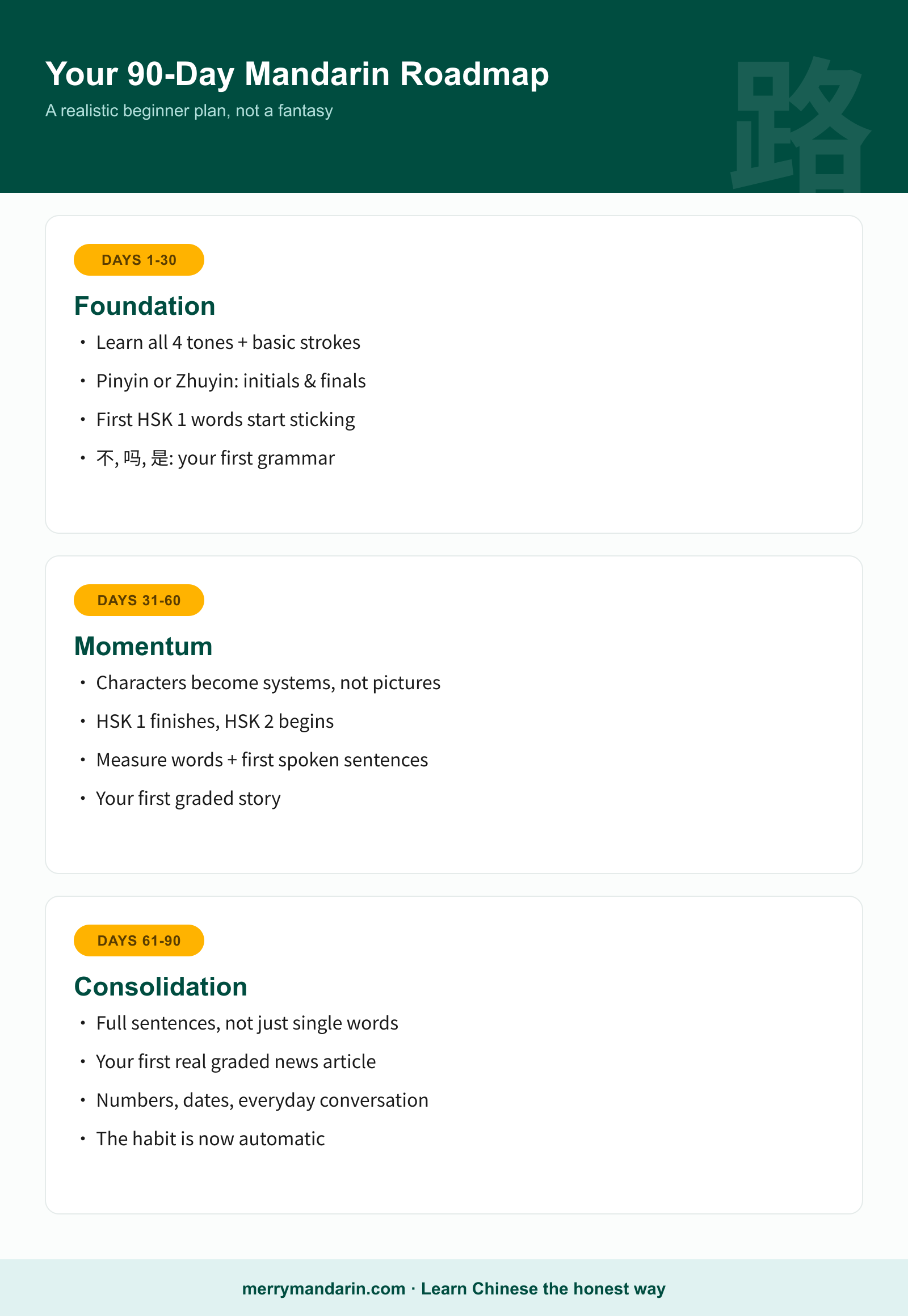
Ninety days from today is a specific date, not a vague someday. Pick your daily number, pick your script, and start the first review session today rather than the “cleaner” Monday three days from now. The plan works because it’s specific enough to follow on the days you don’t feel like it, which, honestly, is most of them.