
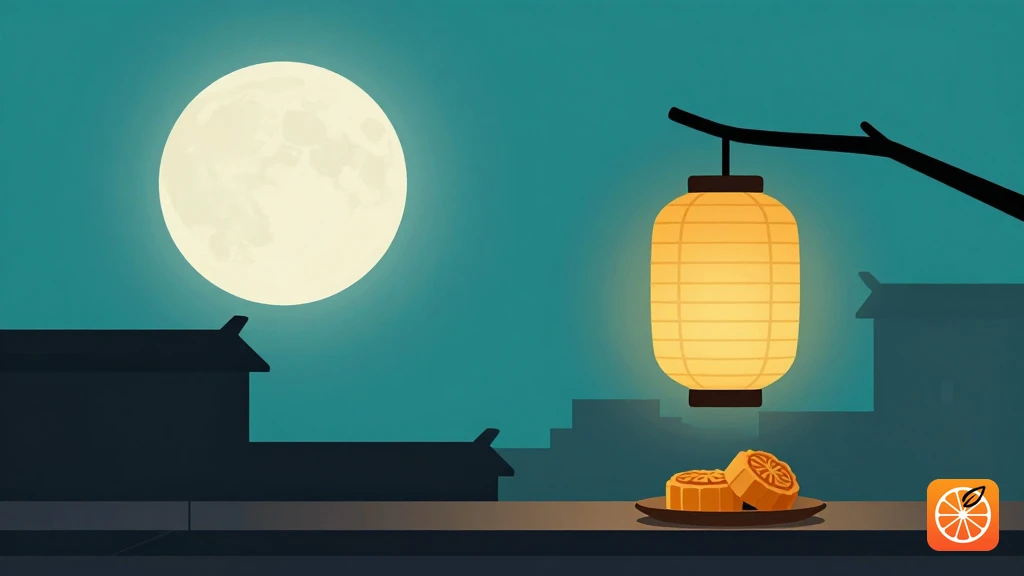
Mid-Autumn Festival in Chinese: Greetings, Mooncakes, and What They Really Mean
Someone hands you a box of mooncakes, or a message lands in your phone with a full moon emoji and 中秋节快乐. Both moments ask something of you that a textbook rarely covers: not the meaning of the holiday in the abstract, but what you’re actually supposed to say back, right now. This year it falls on September 25, 2026, the fifteenth day of the eighth lunar month, the night the moon is at its fullest and roundest of the year. That’s the whole reason the date moves every year on the Western calendar. It’s fixed on a calendar you’re probably not using.
The greeting itself, and the one it’s easy to get wrong
中秋节快乐 (Zhōngqiū jié kuàilè), “Happy Mid-Autumn Festival,” is the safe, universal option. It works in a text to a coworker, a caption on a photo, a line to someone you barely know. It’s the 生日快乐 of this particular holiday: correct everywhere, warm nowhere in particular.
阖家团圆 (héjiā tuányuán), “may your whole family be reunited,” is a different register entirely. It’s not a greeting you’d open with, it’s what you say to someone you actually know is going home, or wish you could say and can’t, because the whole phrase leans on 团圆 (tuányuán, “reunion”), the actual emotional center of this holiday, the same idea behind 团圆饭 (tuányuánfàn), the reunion dinner families build the whole day around.
That second line matters more than it looks. A striking share of the actual conversations around this holiday sound closer to that than to the greeting-card version, which is the part worth getting to before the mooncakes.
The box you’ll be handed
Mooncakes, 月饼 (yuèbǐng), are dense, round pastries traded as gifts for weeks before the festival itself, family to family, colleague to colleague, company to client. The roundness is the whole point: it mirrors the full moon and stands in for wholeness and an unbroken family circle, which is also why a mooncake is traditionally cut into wedges and shared rather than eaten whole by one person.
What’s actually inside the box depends heavily on where in China it came from. Cantonese-style (广式) mooncakes, the ones most widely sold outside China, favor lotus seed paste and a salted egg yolk at the center, meant to look like the moon itself when the cake is sliced open. Suzhou-style (苏式) mooncakes use a flaky, layered pastry closer to a Western pie crust, often savory. 五仁 (wǔrén), “five kernels” or “five nuts,” is the filling that divides people most reliably, a dense mix of walnut, almond, sesame, melon seed, and candied fruit that older generations tend to defend and younger ones tend to skip straight past for something sweeter.
The one line of poetry people actually still use
Su Shi wrote 水调歌头 in 1076, on a Mid-Autumn night he spent away from his brother, and one couplet from it has outlived the rest of the poem in daily use:
但愿人长久,千里共婵娟
Su Shi, 水调歌头 (1076)
Dàn yuàn rén chángjiǔ, qiānlǐ gòng chánjuān: roughly, “may we all live long, and share this same moon though a thousand miles apart.” It shows up on greeting cards and in toasts because it does something most festival vocabulary doesn’t: it admits the distance instead of pretending the reunion happened. It’s the line people actually reach for on a night they can’t get home, not the one people reach for on a night they can.
What “reunion” actually means, in practice
The holiday’s entire visual language, the round mooncake, the full moon, 团圆, sells one specific image: everyone back at one table. For a lot of people that’s real. For a lot of others, it isn’t, and it’s worth saying plainly rather than skating past it. China’s biggest annual travel surge is built around Spring Festival, when hundreds of millions of migrant workers make the one trip home their year revolves around. Mid-Autumn Festival, three days off rather than the full Spring Festival stretch, is often the holiday migrant families spend apart, not together, with the actual reunion saved for the bigger break months later. Chinese state media itself has reported on children of migrant workers who spend Mid-Autumn with grandparents, on a video call with parents working in a different city, rather than the whole family gathered around one table.
None of that makes the holiday hollow. It’s arguably why 但愿人长久,千里共婵娟 has outlasted almost everything else written about this festival: it was written by someone who couldn’t get home either, and it says the honest thing instead of the aspirational one. The greeting-card image and the video-call reality aren’t opposites so much as the same wish said two different ways.
| Situation | What you'd actually say |
|---|---|
| A coworker or acquaintance, any context | 中秋节快乐 |
| Someone you know is traveling home for it | 阖家团圆 |
| Someone who, like you, can't make it home this year | 但愿人长久,千里共婵娟 |
| Giving or receiving a mooncake box in person | A simple 谢谢, thank you, is genuinely enough |
Using this before September 25
The words above are the difference between recognizing 中秋节快乐 on a card and actually knowing which line fits the conversation you’re in, whether that’s a coworker handing you a mooncake box, a family group chat, or the quieter version of the holiday spent on a video call instead of at a table. The family vocabulary underneath the reunion imagery and the gift-giving instincts that carry over from business settings both feed directly into this one night, which is part of why a single festival like this rewards knowing more than one phrase for it.
Merry Mandarin’s FSRS-5 review engine drills real phrases like these against natural sentence variations, rather than as isolated flashcards, so the right line is ready in your mouth when the moment actually calls for it. Free to try.
Related reading
Chinese Family Terms: The Complete Guide to Aunts, Uncles, and Cousins
Chinese family terms explained with diagrams: why 姑姑 and 阿姨 aren't the same word, why cousins split into 堂 and 表, and a family tree for every generation.
Chinese Business Etiquette: The Complete, Ranked Guide
The complete guide to Chinese business etiquette: business cards, gifts, banquet seating, and hierarchy, ranked by real consequence instead of folklore.
Hiking in Chinese: The Vocabulary You Need on the Trail
Chinese vocabulary for hiking, illustrated: what's in your pack, what's on the trail, and what you might see, built around a narrated Chinese story you can watch.