
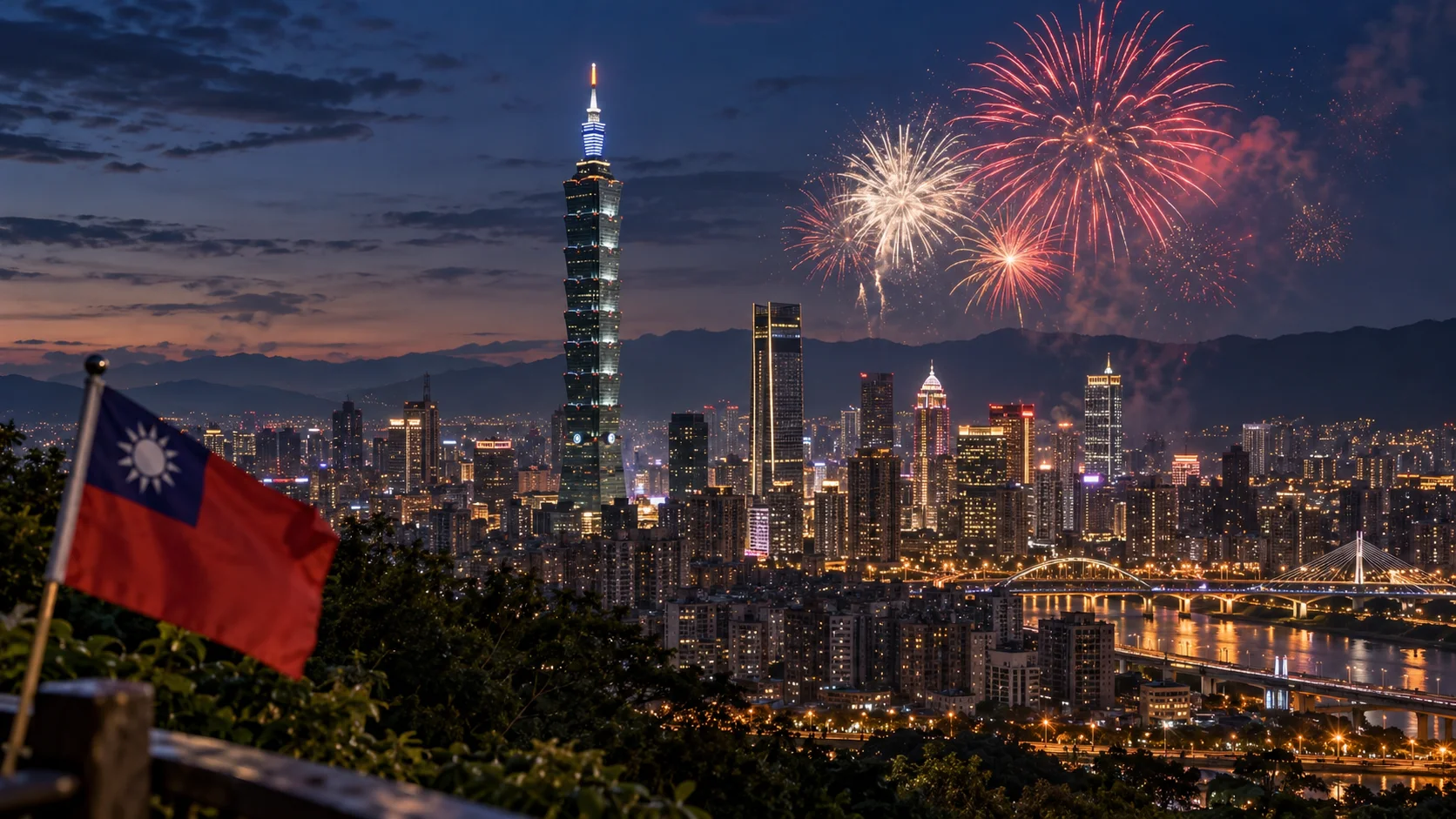
Taiwan's Double Ten Day: 2026 Events and Chinese Words
In early October, the flags begin to appear along roads and outside public buildings in Taiwan. Then comes a morning of ceremonies, a long weekend, and, after dark, the kind of fireworks that make people stop mid-conversation and look up. If you are learning Mandarin, Double Ten Day in Taiwan is also one of those rare occasions when the same useful words keep coming back: on a banner, in a train announcement, in a friend’s plans for the evening.
The holiday falls on October 10, hence the English name Double Ten. In Traditional Chinese, you will see 雙十節 and 國慶日. This year, the official National Day fireworks are planned for Taitung, while Taipei has its own separate display at Taipei 101. Before making plans, it helps to understand both what the day marks and what the words around it actually say.
Why October 10 is called Double Ten Day
The name is wonderfully literal. 雙 (shuāng) means “double,” 十 (shí) means “ten,” and 節 (jié) is a festival or holiday. Put them together and 雙十節 (Shuāngshí Jié) is the holiday on the tenth day of the tenth month. 國慶日 (Guóqìng Rì) is its formal name, “National Day,” and you may also see the shorter 國慶 on posters and in news headlines.
The date remembers the Wuchang Uprising of October 10, 1911, the event that set the Xinhai Revolution in motion. The Republic of China was established on January 1, 1912. Those two dates are easy to blur together, but October 10 marks the uprising, not the formal founding day. Wuchang is in what is now Wuhan on the Chinese mainland; Taiwan itself was under Japanese rule in 1911. The Republic of China government relocated to Taiwan decades later, in 1949, and October 10 remains its National Day there today.
If you notice 民國一百一十五年 on a 2026 event notice, you are looking at the Republic of China calendar rather than a different festival date. Its year 115 corresponds to 2026. Once you know that, an announcement headed 115年國慶 stops looking like a mysterious event from another century.
What is happening in Taiwan in 2026?
There is no single place where everyone gathers. The formal morning celebration takes place around the Presidential Office and Ketagalan Boulevard in Taipei, with flag-raising ceremonies and performances also appearing in city events. This year, the public-sector calendar gives many people a three-day weekend from Friday, October 9, through Sunday, October 11, because October 10 falls on a Saturday. Individual businesses may keep their own hours, so check before treating a favorite shop or museum as open or closed.
The schedule has a particularly vivid shape in 2026. New Taipei City hosts the National Day gala on the evening of October 9 at Banqiao First Stadium. On October 10, the official National Day fireworks head to Taitung, at the Taitung International Landmark by the Pacific. The announced theme, 世界的方舟:南島臺灣 (“The Ark of the World: Austronesian Taiwan”), draws on the island’s ocean setting and Austronesian cultures. It gives this year’s display a sense of place quite different from a generic burst of lights above any city.
If you are staying in Taipei, there is still an evening sky to watch: the city has announced a separate Taipei 101 fireworks and drone display for October 10. It is easy to see a photograph of the tower and assume it shows the official national fireworks, but the 2026 national display is in Taitung. Event times, viewing arrangements, and transport controls can change, so check the local organizers’ latest notices before setting out. The useful Mandarin on those notices begins with the four words below.
-
October 9: National Day gala
New Taipei City's evening program in Banqiao brings music and performances before the holiday itself.
-
October 10: morning ceremonies
Look for 國旗 and 升旗 around the Presidential Office and city flag-raising events in Taipei.
-
October 10: evening lights
The official 國慶焰火 is in Taitung; Taipei 101 has a separate fireworks and drone display.
Four words that make the day readable
These are the words to learn first, because each points to something you can actually see or do on October 10. The first and fourth share 國 (“nation”); the fourth and third share 慶 (“celebration”). Once those links become familiar, the words stop looking like four unrelated blocks of characters.
國旗 is the flag you will see along a road, outside a building, or in someone’s hand at a ceremony. Taiwan’s national flag has a red field with a blue canton and a white sun. You can say 這裡有很多國旗。 (Zhèlǐ yǒu hěn duō guóqí., “There are many national flags here.”) It is a simple sentence, but one you could genuinely use while walking through the city.
煙火 is the everyday word for fireworks, and it pairs naturally with 看 (kàn, “watch”): 看煙火 means “watch fireworks.” On official 2026 notices, however, you will often see 焰火 (yànhuǒ) in 國慶焰火. The two expressions refer to fireworks here; the first character is different, and so is its tone. Recognizing both spellings will save you a moment of doubt when a poster and a friend’s message use different words for the same evening plan.
慶祝 is a verb, “to celebrate.” It works outside National Day too, for a birthday, a graduation, or another happy event. 國慶日 names the day itself, and you can make the friendly greeting 國慶日快樂! (“Happy National Day!”). Another greeting you may encounter is 雙十節快樂! (“Happy Double Ten Day!”). Neither requires a speech about history; it is simply a warm thing to say to someone who is marking the day.
The other words on a poster or in a broadcast
Four words are enough to get started, but an event notice has a few recurring companions. 升旗 is the raising of a flag, so 升旗典禮 tells you a flag-raising ceremony is scheduled. 焰火 is the wording used for this year’s official national fireworks, while 連假 tells you that a notice is about the holiday weekend. Keep an eye out for these before you reach for a full translation of the poster.
A useful way to practise is to read one real announcement and look for the words you know before worrying about the rest. A line containing 國慶日, 升旗典禮, and a morning time is telling you the shape of the event even if a few details remain unfamiliar. Another line with 國慶焰火, 臺東, and an evening time points you toward a different part of the day and a different part of the island. You are using vocabulary to decide what the notice is for, which is much closer to reading in real life than translating every character in order.
If a sign has a word you do not recognize, paste the line into the Merry Mandarin Chinese Reader and tap that word to look it up while keeping the sentence around it. The context matters particularly for event notices: 十月九日 and 十月十日 are only one character apart, but they send you out on different evenings.
Read a National Day notice word by wordPaste a Traditional Chinese event announcement into the free Reader and tap any unfamiliar word in context.
Try it yourselfA few Mandarin lines you can actually use
You do not need a special holiday script. Start with a sentence that fits your plans: 我們晚上去看煙火。 (Wǒmen wǎnshang qù kàn yānhuǒ., “We’re going to watch fireworks tonight.”) If someone is heading to a morning ceremony, ask 你要去看升旗典禮嗎? (Nǐ yào qù kàn shēngqí diǎnlǐ ma?, “Are you going to watch the flag-raising ceremony?”). Both lines use ordinary Mandarin with one piece of holiday vocabulary swapped in.
And if you are simply watching from home, 今天是國慶日。 (Jīntiān shì Guóqìng Rì., “Today is National Day.”) is plenty. The point of learning these words is not to narrate every firework. It is to understand why the flags are out, read the notice that tells you where people are gathering, and have a small, natural thing to say when someone asks what you are doing on October 10.
Related reading
Mid-Autumn Festival in Chinese: Greetings, Mooncakes, and What They Really Mean
What to actually say for Mid-Autumn Festival: the right greeting for the moment, the mooncake vocabulary you'll need, and the honest story behind the holiday's reunion imagery.
Halloween Vocabulary in Chinese: A Night in Taipei
Learn Halloween vocabulary in Chinese with simplified and traditional characters, useful Mandarin phrases, and a street-level look at celebrations in Taiwan.