
Hot Pot in Chinese: Broths, Ingredients & Words for the Table
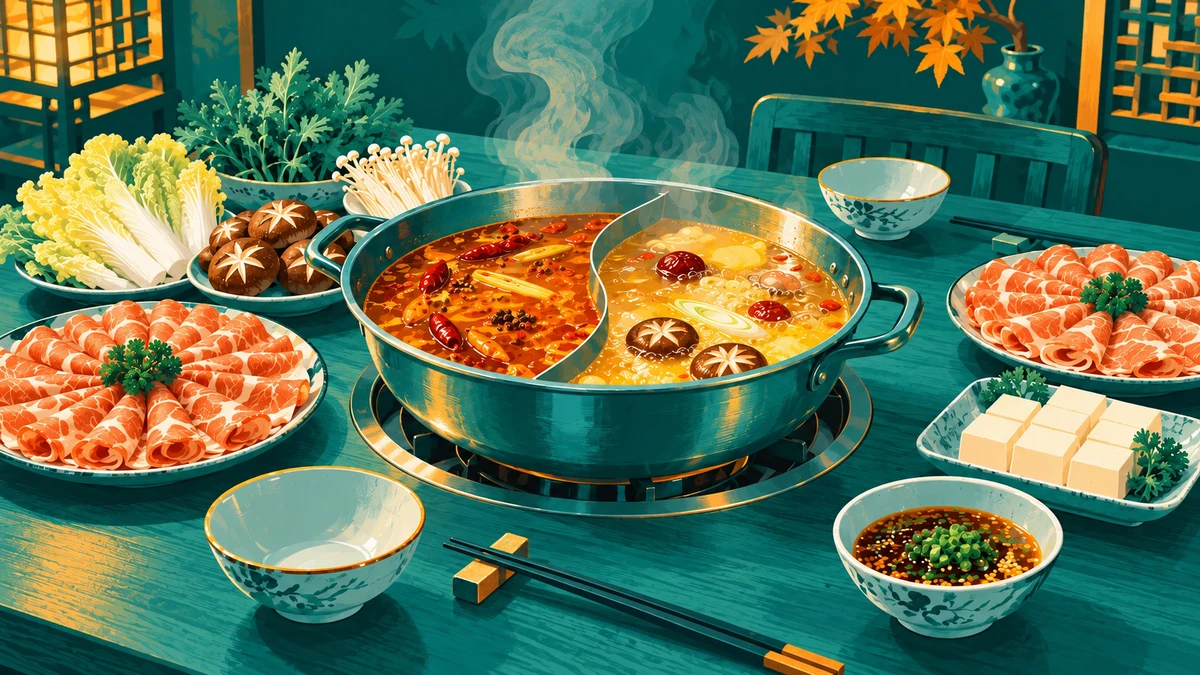
A hot pot dinner arrives in stages. First comes the pot of broth, then plates of meat, mushrooms, tofu, and greens until there is barely room for your bowl. Someone wants the spicy side. Someone else is looking for a piece of tofu that slipped under the cabbage. There is plenty of time to talk while the next round cooks.
If you are learning Chinese, this is a lovely meal to share with friends, but the menu can take a little work. You need to choose the broth before you get to the ingredients, and “spicy” may lead to another question about just how spicy you want it. A few familiar words make that part of the evening much easier.
Here is the Chinese hot pot vocabulary you can use from the first order to the last bowl of noodles. The cards and dialogues show Simplified Chinese first, a smaller Traditional Chinese row below it, and then pinyin. At the end, you can build an order of your own and hear how it sounds.
What is hot pot called in Chinese?
Hot pot is 火锅 (huǒguō), written 火鍋 in Traditional Chinese. 火 means “fire” and 锅 means “pot”. It is an easy name to remember when there is a steaming pot in front of you.

The usual idea is simple: food cooks in a pot of hot broth at the table, and you take out what you want to eat. At some restaurants, everyone shares one large pot. At others, each person has a small pot and chooses a broth of their own. You may order individual dishes, a set meal, or choose from a buffet, so have a look at how the restaurant serves its food before you start ordering.
The word 火锅 covers many kinds of meal. A red, peppery broth is one possibility; a clear soup with cabbage and thin slices of meat is another. You do not have to enjoy very spicy food to enjoy hot pot. The broth menu is where you can find a version that suits you.
A Taiwan menu name to look for: 羊肉炉/羊肉爐
In Taiwan, you may also see 羊肉爐 (yángròu lú), lamb or mutton hot pot. It is a particularly inviting choice on a cool evening, with pieces of meat in a seasoned broth. Recipes vary, including braised versions and lighter soups, so it is worth asking what the restaurant serves rather than expecting the same bowl everywhere.
羊肉 means lamb or mutton. Learn it together with 牛肉, beef, and 猪肉, pork, and you can already recognize several names on a hot pot menu. Our Chinese autumn vocabulary guide has more words for the cooler weather that makes a long dinner around a steaming pot so appealing.
Choose your broth, then decide how spicy
One of the first questions you may hear is 想要什么锅底? (Xiǎng yào shénme guōdǐ?), “Which broth would you like?” Here, 锅底 means the hot pot soup base. You will also see 汤底, another word for the soup base or broth. These are menu choices, so you are being asked what will go into the pot.
番茄 means tomato, and 番茄锅底 is a tomato soup base. 菌汤 is mushroom broth. 清汤 means clear broth, which can be a good word to look for if you want a lighter-tasting soup. Clear broth and mushroom broth are not automatically vegetarian, though. If that matters to you, ask 这个汤底是素的吗? (Zhège tāngdǐ shì sù de ma?), “Is this broth vegetarian?”
麻辣 (málà) describes two sensations: 麻, the tingling or numbing feeling associated with Sichuan pepper, and 辣, the heat from chili. On a menu, it tells you more than the English word “spicy” does. If you order a mala broth, the server may ask how spicy you would like it.
Start with 小辣, mild, if you want some chili heat without ordering the hottest option. 中辣 is medium and 大辣 is very spicy. These are the restaurant’s own levels, not a fixed scale, so one place’s mild broth can still feel quite hot. 不要太辣。 (Bú yào tài là.), “Not too spicy, please,” is a useful extra request.
If you want no chili heat, say 不辣的 (bú là de), “a non-spicy one,” and ask which broth fits. That is often easier than trying to turn a spicy broth into a non-spicy one. A quick 这个辣吗? (Zhège là ma?), “Is this spicy?”, also works when you can point to the menu.
For a group with different tastes, look for 鸳鸯锅 (yuānyāng guō), a pot divided into two sections for different broths. A spicy broth on one side and a non-spicy broth on the other lets everyone choose where to cook their food. The available pairings depend on the restaurant. This conversation uses tomato and mala:
The phrase 一边…一边… names the two sides here: “one side… the other side…”. You can use the same sentence with different broth names. Once the server knows the pair you want, 小辣就好, “mild is fine,” is enough to answer the spice question.
Hot pot ingredients: what would you like in the pot?
The ingredient pages can be much longer than the broth menu. You will usually see meat, seafood, vegetables, tofu, mushrooms, and noodles in separate groups. Start by finding a few things you already enjoy eating. There is no need to learn every cut of meat before you can order dinner.





肉 means meat. You can spot it in 牛肉, beef; 羊肉, lamb or mutton; and 猪肉, pork. Some menus list a particular cut, while others offer a general plate of sliced meat. If the picture looks right but the longer name is unfamiliar, point to it and say 这个来一份。 (Zhège lái yí fèn.), “One portion of this, please.”
一份 (yí fèn) means one portion. It is a useful starting point for dishes on a menu, although the restaurant may sell an item by the plate, weight, or piece instead. For one portion of beef, say 一份牛肉. For another portion later in the meal, use 再来一份牛肉, “one more portion of beef.” You can keep the sentence and change the food name.
Among the mushrooms, 金针菇 are the thin enoki mushrooms that come in a cluster. 香菇 are shiitake mushrooms, while 蘑菇 is a general word for mushrooms. Learning the two specific names helps you order what you actually want, especially when the menu has several varieties.
For tofu, you may see both 豆腐 and 冻豆腐. The second is tofu that has been frozen; it has a more porous texture that takes up broth well. 白菜, Chinese cabbage, is another useful choice to recognize. Its broad pale ribs and leaves make it easy to spot on a plate even before you can read the name.
Then there are the noodles. 面条 means noodles, and 粉丝 are the fine noodles often called glass noodles or vermicelli in English. Order some if you like finishing the meal with noodles in the broth. You do not have to order everything at once; 再来一份… works whenever you want another dish.
If you are vegetarian, 我吃素。 (Wǒ chī sù.), “I’m vegetarian,” is a helpful way to explain what you need. Check the broth as well as the dishes, especially when everyone shares a pot. Choosing tofu and greens alone does not tell the restaurant that you need a vegetarian soup base.
For a closer look at food names you can use beyond the restaurant, visit our illustrated Chinese market vocabulary guide. Many of the vegetables and ingredients there will turn up on a hot pot menu too.
Mix a dipping sauce you actually like
The broth gives the food one layer of flavor, and your dipping sauce adds another. Some restaurants bring you a prepared sauce. Others have a counter where you can put together a small bowl of your own. This is where knowing the words for garlic, vinegar, and sesame paste becomes useful.
蘸料 (zhànliào) means dipping sauce or dipping condiments. The first character, 蘸, means “to dip”. On a Traditional Chinese menu, you may also see 沾醬, dipping sauce. Look for 酱油, soy sauce; 醋, vinegar; and 芝麻酱, sesame paste, then check what else is available before filling your bowl.
Sesame paste and sesame oil are different ingredients. 芝麻酱 is thick, while 香油 is an oil used for its aroma. If you want a simple starting point, try a little soy sauce with garlic and a few drops of sesame oil, then adjust it to your taste. You can always add more; a small bowl is enough to begin with.

The garlic at a sauce counter is often 蒜泥 (suànní), crushed garlic, or 蒜末 (suànmò), minced garlic. 香菜 is cilantro, also called coriander. If you would rather leave it out of a prepared sauce, say 不要香菜。 (Bú yào xiāngcài.), “No cilantro, please.”
In Taiwan, 沙茶酱/沙茶醬 (shāchájiàng), shacha sauce, is another name worth learning. It is a savory sauce used with hot pot, and recipes differ. If you are curious about a sauce you cannot identify, ask 这是什么酱? (Zhè shì shénme jiàng?), “What sauce is this?” That gives you both a useful question and a new word to remember with the taste.
The Chinese you will hear around the table
Once the food arrives, the conversation moves from ordering to eating. You might offer someone more tofu, ask for extra broth, or warn a friend that the food is still very hot. These short phrases are easy to use because the thing you are talking about is right there in front of you.

筷子 (kuàizi) means chopsticks. For cooking, you will also hear 涮 (shuàn), which describes cooking food by swishing it in hot liquid, and 煮 (zhǔ), boiling or cooking in liquid. 涮肉 means to cook meat this way, and 煮面 means to cook noodles.
熟了 (shú le) means “it’s cooked” or “it’s done”. 还没熟 (hái méi shú) means “it isn’t cooked yet”. These are useful words to understand, but they are not a cooking timer: different ingredients need different cooking times, so follow the restaurant’s instructions and cook raw food fully before eating it.
The word 烫 (tàng) is especially useful here. It describes heat that can burn or scald, such as a hot bowl or food straight from the pot. You might use 热, hot, to describe the room or the weather, but 小心烫!, “Careful, it’s hot!”, is the warning you want when someone reaches for a freshly cooked bite.
Notice 麻烦 (máfan) in the requests to add broth and bring the bill. In this setting, it introduces a polite request, much like “could you…” in English. You can use it with other things you need during the meal, too. Add 谢谢, thank you, and you have a natural way to get the server’s attention and ask for help.
You do not have to turn dinner into a lesson. Choose one or two phrases you would normally say, such as offering more food or asking what someone wants, and use them when the moment comes. A phrase is much easier to remember after you have said it to someone across the table.
Practise how to order hot pot in Chinese
Try the menu below with an order you would be happy to eat. Choose a broth, a meat or tofu dish, a vegetable, and some noodles. If you select a mala broth or the divided pot, you can also choose a spice level. The picture and Chinese order will change with your choices.
Build your hot pot order
Choose your broth and three dishes. Try a divided pot to practise choosing two broths, then tap a phrase to see what it means.
Your order
我們要一個番茄鍋底。再來一份牛肉,一份白菜,還有一份麵條。謝謝。
We’d like tomato broth. And one portion of beef, one portion of Chinese cabbage, and one portion of noodles. Thank you.
This is a practice menu. Dish names, portions, and broth choices vary by restaurant. The Listen button uses your browser’s available Mandarin voice.
Tap each part of the order to see its meaning, then use the Listen button to hear the whole sentence. Read it aloud at a comfortable pace. In a restaurant, you can give the order in separate parts and let the server respond between them; you do not need to say the entire thing in one breath.
-
Choose the meal you want
Pick a broth and a few ingredients you enjoy. The names will be easier to remember when they belong to your own order.
-
Say it without reading the translation
Use the Chinese and pinyin first. Check a phrase only when you need it, then say the order again.
-
Change one dish
Swap beef for tofu, or noodles for vermicelli. Keep the sentence and use the new food name.
-
Use one phrase at dinner
Order a dish, offer someone more food, or ask for extra broth when you need it.
You can copy your order into the free Chinese Reader to look at the words more closely. If a restaurant menu has a longer dish name you cannot read, paste that line in as well. Tap an unfamiliar word to check the meaning while the rest of the sentence stays on screen.
Read your hot pot order with tap-to-lookupPaste an order or a menu line into the Chinese Reader and tap unfamiliar words for their meanings.
Try it yourselfFor something to drink afterward, our guide to ordering bubble tea in Chinese walks through sugar, ice, and toppings. You will recognize 要, “want”, and 加, “add”, from this meal.
Before your next hot pot dinner, remember your favorite broth, two ingredient names, and 再来一份, “one more portion”. That gives you somewhere to start. The rest can happen over dinner, with a menu to point to, friends to help, and plenty of time while the pot simmers.
Related reading

How to Order Bubble Tea in Chinese: Sugar, Ice & Toppings
Learn how to order bubble tea in Chinese, choose sugar and ice levels, and name your favorite toppings, with illustrated words and an interactive order builder.

Chinese Vocabulary for the Market: Fruits, Vegetables, and Paying
Chinese vocabulary for an actual grocery run: fruits, vegetables, and the words for baskets, bags, and paying, illustrated and organized the way a real trip to the market goes.